

I have recently revised my entire Substack and to keep the momentum of writing and publishing - I have decided that I would summarise the most important information consumption of the week and publish in the form of Weeknotes. I intend to publish this on every Sunday, starting today June 07th - end of Week 23 of 2026 (using the ISO week numbering system).
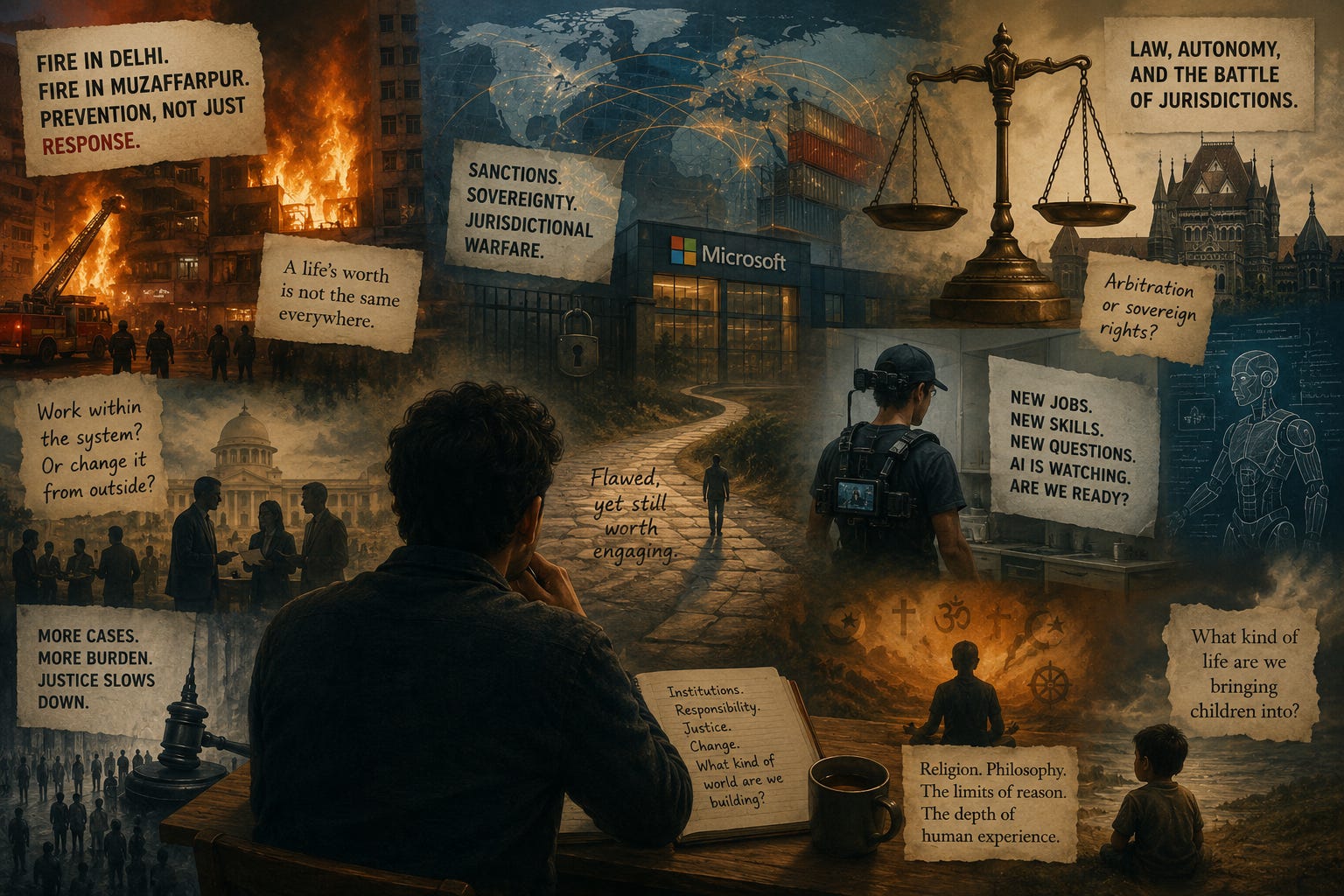
In this Weeknotes, I found myself thinking a lot about institutions and the forces that shape our lives. Two tragic fires - one of them in my hometown and the other in the national capital - raised questions about compliance, state capacity and the value our state place on human life. I also read about sanctions disrupting Indian firm, debates around legal sovereignty and arbitration, the promise and limits of institutional reform, new forms of work emerging from AI, and the growing burden on courts. I encountered arguments about genes and personality, listened to a fascinating conversation on religion and watched a film that asks an uncomfortable question about poverty, responsibility and the ethics of bringing children into the world.
1. Indian Express reporting on Fire in Delhi and Muzaffarpur:
Two fires erupted this week, and there was loss of life in both Delhi and Muzaffarpur. The similarity between these two incidents is that neither was an act of God but rather the result of human non-compliance and negligence. And, as always, the response of the government in both places was reactive rather than preventive. I learned from following the news that the value assigned to a human life in such incidents varies from place to place. For example, in Muzaffarpur, the government granted ₹4 lakh as compensation for each loss of life, whereas in Delhi the compensation was ₹10 lakh. I also learned that most fire accidents in India occur in residential buildings rather than in industries or commercial establishments. There was some encouraging news amidst these unfortunate incidents. A Nigerian couple managed to save themselves because they had watched how-to-videos explaining how to respond during a fire. They ran the shower and stayed low to the floor because, apparently, most people who died in the Delhi incident did not die from burns but from suffocation. It seems that not panicking and maintaining presence of mind, even in the worst situations, can make all the difference.
2. Arush Khanna, Needed a law to shield Indian firms from sanctions
We are indeed living in a globalized world, and it is not only our government and our physical environment that can negatively affect our lives. An Indian firm was affected because one of its investors was Russian. The United States sanctioned Russian entities and instructed American firms not to engage in business with them. As a result, Microsoft blocked access to its software for the Indian firm. India currently does not have laws to protect its firms in situations like this, whereas the European Union and Russia have enacted what are known as blocking statutes. These statutes essentially protect domestic firms from the extraterritorial effects of sanctions imposed by other states by incorporating clawback rights, whereby damages suffered by a firm can be recovered through legal action against assets connected to the corresponding firm of the sanctioning state. The article suggests that India could consider adopting a similar blocking statute, although such a measure would need to be carefully balanced with India’s desire to maintain a neutral geopolitical stance. The article also highlights an issue that is likely to be tested before the Bombay High Court, where a Russian firm is asking the court to give precedence to a Russian court order over an arbitration agreement between two companies. We will have to wait and see what prevails in this situation: the sovereign authority of Russia, the sovereign authority of the United States, or the arbitration agreement between private parties. This jurisdictional warfare and alignment are highly contemporary issues, particularly in light of President Putin’s recent remarks describing India as a reliable partner.
3. Vrinda Shukla, When a distorted autopsy denies justice
Why do only government hospitals conduct autopsies when there are often insufficient resources and trained personnel, and when videography is sometimes carried out only under significant political pressure? An article by an IPS officer argues that private hospitals should also be engaged in the process. She makes the case in light of the recent Twisha Sharma incident.
4. Nirbhay Rana, No Policy around Weather Appropriate Clothing
This article highlights a policy flaw: the prescription of school, industrial and institutional uniforms often ignore local weather conditions. I see the same problem in my profession as well and have never been able to understand why practicing lawyers are required to wear black coats and move around courts in such extreme summer heat.
5. Shashi Tharoor, Change happens in mundane Politics
When we are angry or hurt, it is natural to want to overthrow the source of our agitation. That source may be an individual or the existing system itself. However, Shashi Tharoor argues in this article that many institutions in India continue to function and that meaningful engagement with them remains possible. One can work through various institutions, interact with different stakeholders, and prepare well-crafted advocacy notes to bring about change. We must not forget that, flawed as our institutions may be, we would be worse off without them. I particularly loved one passage in the article, which deserves to be quoted in full,
If all else fails, take your case to court. But for that, you need to have a case, not just a set of slogans or memes expressing your frustrations. Turning “this is unfair” into “this violates Article 14 or Article 21” makes you impossible to ignore.
Meeran Chadha Borwankar, in another opinion piece, has been highly critical of this editorial. She is an IPS officer who has worked within the system and argues that despite being part of it, she was unable to bring about meaningful change, as were many of her colleagues. This raises an important question: who is actually capable of bringing substantial change to society, or at least who is best positioned to do so?
6. Sakshi Sadashiv, Building Robots to act like Humans
Among the new jobs emerging in India is that of a physical AI trainer. Such individuals perform their regular jobs while wearing multiple devices, including cameras, allowing AI systems to observe them and learn skills that may eventually be transferred to robots. This category of work gained wider public attention in India after Pronto, the Bengaluru-based home-services startup, became embroiled in controversy over allegations that it sent camera-equipped workers into customers homes to collect footage for physical AI training. The article highlights that several firms, such as Micro1, Egodata, Humyn Labs, Neocambrian, XP Robotics, Human Archive and Cynlr, are involved in training robots to replicate human behaviour and physical skills.
7. Access to Justice in the Age of AI: Evidence from U.S. Federal Courts
I have not yet read the paper, but it appears to be quite interesting. The abstract states that the number of self-represented litigants in U.S. federal courts is increasing dramatically. Such cases are apparently placing a greater burden on federal district courts, as judges are required to process more cases. Moreover, these cases are not being resolved more quickly; they are simply being filed at a faster rate.
8. Laurie Clarke, How much of our personalities are determined at birth?
The article is an extension of the longstanding debate between nature and nurture. Are we primarily products of our genes, or are we shaped by our circumstances? It discusses an interesting case in Italy where an accused person reportedly received relief from the court after it was established that he possessed what was described as a “warrior gene.” The article argues that a substantial portion of our personalities is determined at birth and that only a relatively small part is shaped by life experiences. Here is an interesting passage.
The human genome is an unwieldy beast: there are 23 chromosomes, containing around 20,000 genes between them. These are further subdivided into about three billion “base pairs” – the smallest unit in the genome – which are typically conceptualised as pairs of letters that unfurl in a particular sequence. All humans share 99.9% of their DNA, meaning only a miniscule 0.1% of the genome accounts for our differences. We now know personality differences are polygenic and poly-environmental: meaning many genes and small life experiences combine to create who we are.
9. Johnathan Bi in conversation with Jeff Kripal on Religion
The guest on this podcast studies religion and teaches Rice University. I found the conversation deeply enlightening because it helped me understand why philosophy may ultimately be more important than politics. After all, what is politics trying to achieve? Even if complete equality and fairness were achieved, individuals would still suffer unless they found satisfactory answers to the deeper questions they carry within themselves. The conversation also helped me understand why spiritual leaders often present solutions that may not withstand strict scrutiny but nevertheless seem to produce transformative results for those who are suffering. The guest compared this phenomenon to the placebo effect, wherein a substance with no inherent medicinal properties can still produce healing because it influences the patient’s mind. We should approach religion, and indeed all religions, through the lens of the plurality of human experiences. The problem with religion is that while it may provide answers, it can also confine individuals within rigid identities. We should take individual experiences seriously rather than dismissing them as merely anecdotal or rejecting them because a nineteenth-century materialist framework tells us to do so. The richness of such experiences often cannot be tested within controlled scientific environments. People with thick skin and highly analytical minds may sometimes find it difficult to experience what others describe as miracles.
10. Prime, Capharnaum (2018)
The movie raises an important question: should people who are unable to provide for themselves continue having children? The title of the movie means “chaos” in Arabic. It is derived from a biblical town condemned by Jesus as one of the three cities that refused to repent despite witnessing his miracles of healing. There is a beautiful scene in the movie in which a child pleads and says the following,
Zain: I want to make a complaint against my parents. I’d want adults to listen to me. I want adults who can’t raise kids not to have any. What will I remember? Violence, insults or beatings, hit with chains, pipes, or a belt? The kindest words I heard were get out son of a whore! Bug off, piece of garbage! Life is a pile of shit. Not worth more than my shoe. I live in hell here. I burn like rotting meat. Life is a bitch.I thought we’d become good people, loved by all. But God doesn’t want that for us. He’d rather we be washrags for others. The child you’re carrying will be like I am.